Monday, May 31, 2010

Dance Fever

Each delegation to the Festival for Hope 2010 is supposed to put on a performance for the other delegations which is representative of their country and culture.  There are 32 delegations, each with eight players and two coaches, thus 300 plus people as the audience.  Plus, African dance, enough said.  It was time to take this performance seriously.

In our experience, soccer players aren't often known for their dance or musical skills, except maybe Alexi Lalas.  We needed to bring in the experts so the Cambodian squad wouldn't totally embarrass themselves or the Khmer culture.  We went to the Phare Ponleu Selpak, a widely-respected arts NGO in Battambang who got its start using art to help children in refugee camps on the Thai border to overcome the trauma of war.  After a discussion of the performance options, we chose a simple traditional Khmer dance, the Plowing Dance, or so we thought.

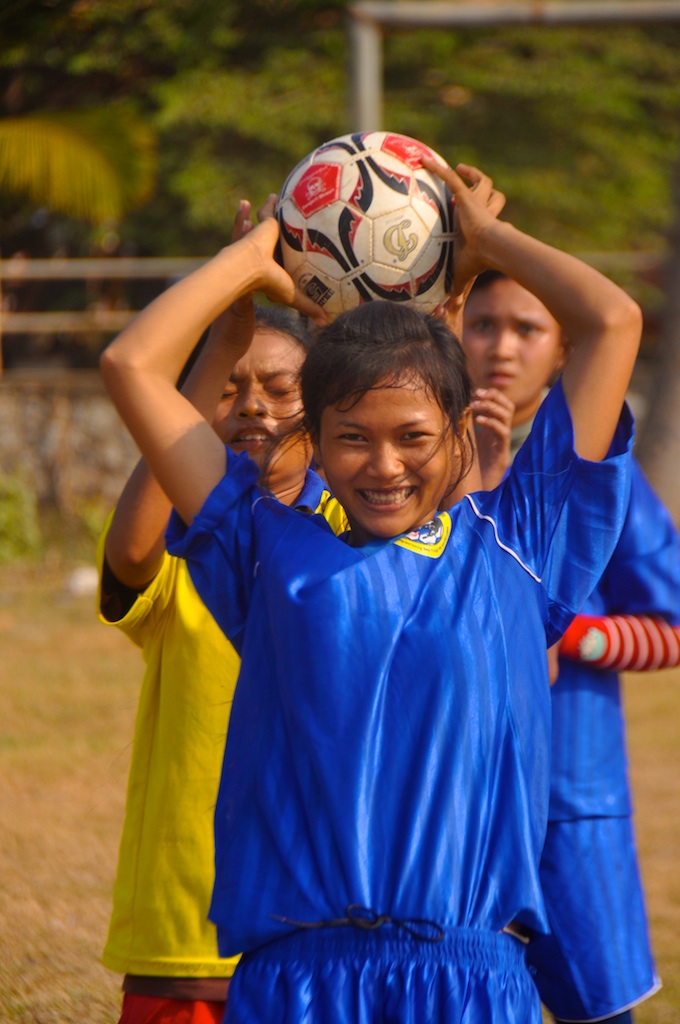
Session One - the team, fully kitted out in their bumble bee uniforms (see photos for futher explanation), as soccer practice was to follow the dance lesson, descended on the NGO complex, which trains and houses hundreds of children, holds a weekly circus and other performances.  The team did not seem especially enthusiastic about dance class, but as obedient Cambodian youth, they quickly set to work helping the dance instructor ready the stage for class - hauling speakers, chairs and props into position.

The class began with some simple warm-up exercises where it was quickly apparent the dance instructor was the most flexible man on earth while the team could hardly touch their collective toes.  In yoga classes, you are told to spread your toes and try to work each toe like it is a finger, something most westerners are incapable of doing.  The dance instructor's toes are more flexible and nimble than my fingers and he could easily play the piano with them.  Another early observation was the overall lack of rhythm by the majority of the team.

The Plowing Dance depicts the rice harvesting process, which, as you can imagine, is very important to Cambodian culture.  It is set to a beautiful, haunting song and the male part is much more difficult than the female part, requiring two bamboo poles as props, which must be maneuvered and pounded on the ground in a graceful fashion to the beat of the music.  Our boys gave it the old college try, but it was easy to see the instructor's frustration due to the lack of ability from the team.  The girls weren't much better, but luckily, a dance pixie, in the form of a ten year old resident, who was watching in disgust from the side lines, took the girls under her wing and taught them their part with grace and patience.  The session ended with some progress having been made, but with the understanding that a lot more work was needed.

Session two - practice began with a costume viewing, with Vaneath as the guinea pig.  After he was swaddled in yards of Khmer cloth, similiar to a baby's diaper, we decided we might find our own more comfortable and dignified costumes at the local market.  Surprisingly, the team seemed to have retained some muscle-memory of the dance and actually seemed to enjoy it, unlike the scowling faces from the first practice.  Mabye they had resigned themselves to the fact that there was no way to get out of this, so why not have some fun.  After a few hours practice, timing, synchronization and rhythm still leave a lot to be desired, but they seem to at least know the dance.  Luckily, there is one more practice before taking this show on the road.  Wish us luck!!

Thursday, May 20, 2010

Road Trip Part 2 - Sabai Klang Nah

When the two Spirit of Soccer trucks pulled up to the Beach Road Hotel Friday afternoon, the team members were literally bouncing off the walls of the vehicles.  The hotel is in the center of the action in Sihanoukville, Cambodia's main beach town, and it is an upscale backpacker hotel with very few Cambodian guests.  The front desk is located at the back of the bar/restaurant and two feet from a pool table.  When two barangs (Cambodian word for white foreigners) came into the lobby with 11 Cambodian kids and two Cambodian adults, the entire room turned to stare.  While the check-in was being sorted, the team played pool, completely oblivious to the fact that they were the center of attention; something they would be for the entire weekend.

After unloading the gear in the rooms, it was time for the beach.  We tried to convince the team to change into shorts rather than sport jeans and longsleeves, but no luck.  The 1/4 mile walk to the beach was somewhat overwhelming as the street is filled with tourist shops, barang backpackers and bars.  Everyone grabbed hands with another team member for support.  In Cambodia, it is not unusual to see two kids or adults of the same sex walking down the street holding hands.

Once we hit the beach, and after a minute or two of staring at the water, the entire team ran pell mell into the sea fully clothed.  It was a sight to see!  They frolicked in the water laughing their heads off while tossing the soccer ball around,  yet again the center of attention for all the tourists on the beach.

Savin had a huge grin on her face and when we asked how she was, she said, "Sabai Klang Nah", directly translated as happy strong very.  It was truly amazing to see so much joy and wonder as the team had their first experience in the ocean and playing in the sand.

After returning to the hotel, the team asked if they could go in the pool.  None of them have ever been in a pool before.  Upon the affirmative answer, 11 sandy, beddraggled, fully-clothed Cambodian kids dive bombed the pool to the horror of the other hotel guests.  It was like the scene from Caddy Shack when the caddies take over the pool, minus the baby ruth part.  The other people in the pool quickly made their way to the far side of the pool, away from the crazy Cambodian kids, and after about ten minutes, the team had taken over the entire pool while the rest of the guests stared in a mix of horror and fascination from the surrounding lounge chairs.

The next day, the team had evaluations with social workers and psychologists from a local NGO to check their readiness for travel and to help open dialogue about their fears about the trip.  Team members are nervous about being away from home for two weeks, eating non-Cambodian food and the language barrier.  A few mentioned neighbors in their village brought up the issue of human trafficking and safety.  Human trafficking is a big problem in Cambodia, esepecially for young village girls.  Their fears were allayed about safety concerns and trip expectations through discussions with other Cambodian kids who have traveled internationally and the team was given additional explanation about the journey ahead.  We learned that not only do we need to travel with a rice maker and locally produced rice, but we also need to bring dozens of ramen noodles in case the team won't eat the food offered in South Africa.  Asians in general don't like food from other countries and Cambodians in particular do not really eat food from outside their region, let alone their country. 

After two days of playing soccer, swimming, laughing and bonding as a team, it was time to return to Phnom Penh.  The girls sang, giggled and snacked the entire four hours back to Phnom Penh.  We made a quick stop at the airport so the team would be more comfortable on the departure day and talked about departure gates, checking bags and customs while everyone chomped down on their first Dairy Queen soft-serve cone.   

Finally, time for the mall!  Sunday afternoon is a busy time at the mall in Cambodia, but add a holiday Sunday afternoon to the mix and you get utter mall mania.  The mall is more of a social excurison than a buying excurison - air conditioning, escalators, window shopping, fried chicken outlets and more. 

The team entered the Sorya Center in excited anticipation with their eyes growing wider and wider upon seeing all the people, the bright lights and the famed escalator.  After a quick explanation about the escalator, we hopped on for a trip down.  All the girls grabbed the nearest arm to hold onto and screeched in fear and delight as if they were on a roller coaster.  We yelled to 'jump off' at the bottom as they truly didn't know what to do.  (Sidenote:  In any other country, the Sorya Center would not really even be considered a mall, but in Cambodia, it is the best we can do and almost as big a deal as Disney World.)

The final cultural excursion of the weekend was a quick trip around the grocery store.  Again, no one on the team had been into a grocery store as they do their shopping in local markets, often with live animals and just picked produce.  They stared in fascination at neatly cut hunks of meat nicely wrapped in plastic, mesh bags filled with produce and gasped at the cost of the food.

What a weekend!  It was a real honor to share some of the outside world with the Football for Hope Team.  They are officially ready for South Africa!

Sunday, May 16, 2010

Road Trippin' Cambodia Style - Part I

The middle of May finds all of Cambodia celebrating the King's Birthday, a three day celebration plus the weekend, and one of the few non-religious Cambodian holidays.  In good Cambodian custom, Spirit of Soccer took the team on the road, Kampuchea style, as a warm-up trip for South Africa.  The trip was to include a training at the National Football Center with the U-14 national team, a press conference, meetings with social workers to assess the team's readiness for international travel and some well-deserved beach time. 

The two Spirit of Soccer coaches, Heang and Kamsort, gave up their 5-day holiday with their families to accompany the team to Phnom Penh and Sihanoukville.  Cambodians typically spend holidays with family and it is unusual to leave your family for travel on your own or with a group.  Kamsort is the mother of two young children and it is a big sacrifice for her to leave her family for this trip and the trip to South Afrca.  Both coaches are incredible with the team - Heang offers the coaching leadership and discipline and Kamsort gives the individual attention needed, especially to the girls.

The team members assembled in Battambang from their various villages where two big white land cruisers that scream "NGO" were ready for the 4-hour caravan trip to Phnom Penh.  Rather than divide up into the two cars equally, the team decided to put all the bags in one rig and travel together in the other vehicle with the two coaches, a mere 13 people in one truck.  We watched in bemusement as all eleven players climbed into the back of the truck in the 95 plus degree heat for the journey.  And, typical to Khmer, all the kids were wearing jeans, long-sleeve shirts and hoodies while us westerners were dressed in the least amount of clothes considered culturally allowable.

Of course, two hours into the journey, a lunch stop was required.  It isn't a road trip in the Kingdom of Wonder without a long, drawn out stop for a meal, a snack or a picnic.  This stop isn't a quickie in and out at the drive-thru, but a sit-down meal with multiple courses and conversation.  Cambodians would never understand the concept of beating your past record for a trip.  It is worth mentioning that Cambodian 'road food' is nothing like western road food as there are no fast food restaurants or convenience stores en route, only a few gas station shops and locals selling fruit and other non-packaged products.  The team members snacked on bags of snails, green mangos, dried fish, fried bananas and other wholesome, yet smelly, products in the truck prior to the lunch stop.

The number one thing the team wanted to do upon arrival in Phom Penh was visit the Sorya Center, a mall with a grocery store and escalator.  This much anticipated stop was slated for the Sunday return to Phnom Penh.  All of the team members had  heard of the famed Sorya Center, but had never been to a mall, visited a grocery store or ridden an escalator.

After a late arrival in town, the team had a early night in preparation for the morning training session and press conference.  The Cambodian Football Federation has been incredibly supportive of the team and has assisted in much of the travel logistics.  The team was naturally nervous about playing at the National Football Center and were a little unsure of what to expect.  Their fears heightened when they arrived at the pitch to have TV cameras and reporters following their every move.  They, of course, acted like pros who were used to the paparazzi following them around on a regular basis.  Good thing the boys all had their best hairdo, a la a Beckham, for the big day.  (Sidenote, every two weeks when the team comes together, four of the five boys have changed their hair, whether is is new sideburns, a dye job or a radical haircut.  They are true slaves to fashion.)

The training included stretching, drills and five v. five games.  The two groups blended seamlessly and put on a good show for the press.  After the training, the press conference began.  This was the team's second press conference and they acted like old hats.  Sengvy, the team's captain, even grabbed the microphone, introduced himself and spoke on the team's behalf in front of the cameras, the reporters and the Football Federation's General Secretary.  Each team member was awarded a national team jersey and wished good luck by all in attendance, aware that they are now representing Cambodia internationally.

After the hard work, it was time to head to the beach.  The team finally agreed to split up into two cars - girls in one and boys in the other.  From here on out, the world outside was all new to them.  No one had been to the beach before.  As we moved closer and closer to the shore, the level of excitement built and the team was in a near frenzy.  At one point, Vrak spotted an airplane flying above us, just after it took off from Phnom Penh Int'l, and the whole truck went into excited hysteria as they had never seen a plane flying before.

Stay tuned for Part 2!!

Thursday, May 6, 2010

The Girls from Bour Village

Kunthea, Socheata and Channou, three girls on the Spirit of Soccer Football for Hope team, all come from Bour Village, Battambang Province.   The village is a two plus hour drive from Battambang, the provincial capital, with well over half the drive on a teeth-rattling, bone-jarring dirt road.  The pastoral setting with palm tree-lined roads and mountains off in the distance doesn't give the passerby a sense of the problems faced by the villagers.
The village is home to approximately 1000 people and is without running water or electricity.  During the rainy season, the roads often get washed out and it can be very difficult to come or go.  Despite its isolation, Bour Village sports at least five cell phone vendors and cell phone reception is better than most parts of the US.  Most inhabitants are farmers and many farms are backed up against landmine fields.  Water is delivered in giant cisterns on the back of a motorbike trailer and becomes home to mosquito larvae, leading to malaria which is a serious problem faced by villagers in Cambodia. 
Until a few months ago, the local school was nestled up against a 17 hectare landmine field, there's now a 50 meter buffer between the school and the live explosives.  You can still see the landmine signs from the school soccer field.

Kunthea has eleven brothers and sisters and her father is a farmer.  She currently is unable to go to school because the nearest high school is over an hour away by dirt road.  Kids from Bour Village either must move to the village with a high school and stay with a family member or spend $4 and over two hours per day on the back of a motorbike commuting or drop out of school.  Kunthea helps her mother around the house and is a mean soccer player. 

Socheata's family lives too far from the school, so she moved in with her sister, brother-in-law and niece so that she could attend school.  She lives in a one room thatched-roof hut with an outhouse out back.  She is a model student, speaks a little English and is a leader on the team.  Her positive attitude and her smile are infectious.  She sites the lanmines, lack of paved roads and no nearby highschool as the biggest challenges she faces in her day to day life.

Channou lives with her parents and 9 brothers and sisters far outside of town and it takes at least thirty minutes for her to get to school.  Her family is very excited for her to go to South Africa, even though they don't completely understand where it is or what the tournament is about.  They are excited she is receiving vaccinations, soccer training and getting a chance to meet players from other villages.

The fact that these three girls all come from such poverty and face many challenges on a daily basis and still manage to bring so much energy, liveliness and hard work to the Football for Hope Team is inspiring to all who come into contact with them.

And despite their rural and isolated homelife, they are typical teenage girls.  They love to giggle and gossip with each other, are concerned about their appearances and love to shop.

Wednesday, April 21, 2010

Technology Hits the Rice Paddies

One of the great benefits of being part of the Football for Hope Festival 2010 is the access to the World Cup sponsors.  The World Cup is sponsored by adidas, Sony and Coca-Cola, among others.  adidas will outfit each delegation with uniforms and other gear upon arrival in South Africa, which is a huge bonus for each team.  Sony is sponoring a photo competition among participating delegation (32 groups representing 50 countries) which includes a donation of two cameras, a laptop, a GPS and a photo printer plus a trainer to teach the team how to use the equipment.

Sony Singapore, as the closest Sony office to Cambodia, flew a contingency up to Phnom Penh and braved the four hour death-defying drive to Battambang to officially kick-off the partnership.  A press conference was held with the Sony exeutives, local media, Spirit of Soccer and the team.  As all good press conferences require, lots of photos were taken of the event, especially of the team.  If the team seem bewildered by all these dressed up adults handing them boxes of technical equipment, they didn't show it on their smiling faces.  They acted as if they did this kind of thing every day, rather than help their parents in the rice fields and take care of farm animals.

As stated previously, the majority of the team lives in villages with no electricity and certainly no laptops or wifi are in use by the local residents, in the schools or by local government officials.  Thus, the kids were being introdued to totally foreign technology with no frame of reference for much of the typical training jargon and procedures.

The Singaporean trainer, Casey Teo, was enthusiastic about the task at hand while bringing a sense of excitement about the subject matter.  As he doesn't speak Khmer, one of the coaches had to translate the entire training and it can be hard to translate technical terms, especially if you don't really understand the terminology yourself!  In a classroom setting, the team was introduced to the basic functions of a digital camera, simple photos and care of the camera.  Their eyes were huge as they passed around the cameras and they couldn't containt their giggles once they were allowed to snap away.

The idea behind the contest is for each team member to take the camera home to document their life, family, friends, hobbies, etc.  The kids love taking pictures and love getting their photos taken even more.  All youth in Cambodia give a reverse peace sign, often with their arms crossed, for all photos and these kids followed this time honored tradition.

The first day of training was informative and well received.  The day ended with a field trip to a local Pagoda to practice the newly learned skills.  Cambodia offers so many great opportunities for unique and beautiful pictures and this outing didn't disappoint.  The group of teens toting cameras piqued the curiosity of the local kids playing near the Pagoda.  Soon the team had a merry band of half-naked kids mugging for the camera, trying not to be outdone by the local cows roaming the sacred area or the coverful Buddhist temple as subjects for the budding photographers.

Day two started off successfully as the team learned how to print photos.  Each team member printed a photo to take home as a souvenir of the weekend.  The boys all wanted a picture of themselves, posing, while the girls wanted group shots with the other girls.  As each picture magically came out of the printer, the team watched wide-eyed and burst into peals of laughter once the photo was finished.  The team was bonding off the field and a shared awe of digital photography was helping break down the barriers between the boys and girls in this very traditional society.

The introduction of the laptop, the internet and a camera GPS was when the cultural gap began to rear its ugly head.  The trainer started off talking about the battery life of the laptop and how it must be plugged in to recharge the battery.  Although we had told him about the lack of electricity in most of the team's homes, he didn't seem to grasp that reality.    Continuing on, he tried to explain how the GPS could show where the photos were taken on google earth.  He pulled up google earth on the laptop to show the team a map of the area and how the photos would be pinpointed on the map.  Of course, they had never seen the internet, nor a map of the area and they defintely couldn't  come close to understanding the concept of the GPS (satellites, trajectory and longitude/latitude).  Our translater, an educated but rural Cambodian, was pretty lost on trying to explain the GPS in Khmer as he didn't understand it himself.  As the confusion started to mount, we cut the session short to do a quick recap on the cameras and photography before the cameras were taken to the villages to document a day in the life. 

Results from the team soon to come...

Thursday, April 8, 2010

Logisitics

Group travel generally requires a high level of organization, coordination and planning.  Group travel in Cambodia throws these basic tenets out the window, subsituting them with patience, luck and connections.

Passports, plane tickets, vaccinations, visas are the key ingredients to international travel and without these four checked off, the trip is going nowhere fast.  Puchasing plane tickets was the top concern for the trip to South Africa since airfare was rapidly rising as the official countdown to the World Cup had begun in December. 

Step number one, translate all team members' names from Khmer (Cambodian script) into Latin letters.  The Khmer alphabet has 33 letters and names don't easily translate into just one spelling.  Each time a name is translated, it typically has a different spelling and this isn't unusual in Cambodia.  To illustrate this point, one of the Cambodian Spirit of Soccer coaches has his name spelled differently on his passport, driver's license, facebook and email.  After stressing repeatedly that the spelling must be uniform and going back and forth on what the final spelling would be, each team member had their name translated into their "official" name for all future documents in English.  This is the name that each team member will identify with for the rest of their lives and it is a big responsibility to determine what that name will be.


Step number two, find cheap and relatively direct plane tickets for 12 people from Phnom Penh to Johannesburg during the last two weeks of the World Cup, the world's largest sporting event.  After exhausting routing options and airline choices with the local travel agent, with prices rising by the day, the most practical option was to buy directly from the airline in hopes of securing a group discount.  The group discount did not pan out after many emails, phone calls and pleas with the airline, all very difficult with the language barrier and lack of concrete contact information.  As we say in Cambodia, two steps forward and one and a half steps back (at least).

After finally booking the tickets, the question of payment was broached.  In Cambodia, almost all transactions take place in cash and if a credit card is used, a hefty percentage fee is tacked onto the price.  Option one - go to the bank and draw out thousands of dollars in cash, which is never an easy undertaking.  Option two - pay with a credit card and deal with ensuing headaches to make the transaction happen.  We chose option two as the airline waived the credit card fee and it is safer to have American Express on our side in case something happens with the trip.  After numerous international phone calls to American Express to get the transaction approved, at least five trips to the airline office and several phone calls to the airline's bank, we were able to buy the plane tickets.  All told, the ordeal took over 30 hours.

Cambodian bureaucracy is difficult to navigate, especially for foreigners.  Securing passports is a difficult task at best and monumental at worst.  Luckily, Spirit of Soccer works closely with the Cambodian Football Federation (FFC) and the FFC was able to help with the passport process.  After completing dossiers on each team member, something akin to what was compiled by the CIA on Jason Bourne, with letters from the parents (many who do not read or write), letters from the regional Ministry of Education offices okaying the trip, letters from each local commune council and letters from the Football for Hope organizing committee, the passport process had begun. 

All in all, the process was running smoothly until a last minute request required all parents and team members to travel to Phnom Penh for a visit to the Passport Office.  Phnom Penh is over four hours away from the provinicial capital, Battambang, where the team meets every other weekend.  The team members live one to three hours away from Battambang, many coming from villages on dirt roads with no running water or electricity.  Assembling the bewildered parents in Battambang to travel to Phnom Penh, where most of the parents had never been, happened quickly and efficiently.  With the parents traveling by tourist bus and the team traveling by Spirit of Soccer vehicles, the group of 26 pulled into Phnom Penh late Sunday afternoon and was already on its way back to Battambang at 2:00 Monday afternoon with photos taken, documents signed and fees paid. Passports were issued within the week!  A night's stay in the Capital in a hotel with air conditioning was a once in a lifetime experience for many of the parents.

The team now has plane tickets and passports for South Africa.  Watch out Festival for Hope 2010, the Cambodian delegation is on its way!

Thursday, April 1, 2010

Meet the Team

The Spirit of Soccer Football for Hope 2010 team is comprised of eight girls and boys from rural Cambodia who all live in landmine affected areas. Each player was selected for the team based on their participation with Spirit of Soccer programs, soccer skills, personality, team work and commitment.

Here is the team:

Linda Choeun is from Pailin town and has been playing soccer two years and her favorite subject in school is English. Her father lost part of his leg to a landmine, so she is very aware of the dangers of landmines. She is a leader among the team, trying to emulate her favorite player, Ronaldo.

Sengvy Ridam is from Banaan village and wants to travel to South Afria to play soccer and learn about the different culture. His favorite player is Rooney. The most people he has ridden a motorbike with at one time is four.

Naroth Vann is also from Pailin town and has been playing soccer for four years. She too has personal experience with landmines as her neighbor lost his hand to a landmine. She wants to go to South Africa to share the culture of Cambodia and tell people about the problem of landmines.

Vith Yem is also from Pailin town and sees landmine signs all over his village. He has played soccer for five years and Andreas Savin is his favorite player. He has the best hair on the team!

Channou Keng is from Bour village and has eleven siblings! She has never been to Phnom Penh, the capital of Cambodia, but is excited to travel to South Africa. She has a huge smile and is a great addition to the team.

Vanneath Kheng is from Somloth village and has a landmine sign in front of his house. He wants to be a soccer coach when he grows up and Beckham is his favorite player. He is a hard worker on the field and also loves to play volleyball.

Socheata Seng is from Bour village and has an uncle injured by a landmine. She is excited to travel to South Africa to see the difference between South Africa and Cambodia. She loves Beckham and mathematics.

Vrak Phon is from Sampouv Loun village and has to travel up to five hours by dirt road for training every other weekend. He has been playing soccer ten years and has seven brothers. He wants to be a pro soccer player when he grows up and he definitely has the moves and personality.